

 7:19 PM
 ngetoyo

 The Toyota Sienna is a family minivan currently manufactured by Toyota at Toyota Motor Manufacturing Indiana in Princeton, Indiana, United States for the North American market. It replaced the first-generation Previa van in 1997 with a more conventional front wheel drive layout and shares a heavily revised platform with the Camry. Both the Previa and original Sienna were smaller than the other minivans they competed against, but a redesign in 2004 increased the dimensions to match those of its competitors. The Sienna is currently the only minivan in its class to offer all-wheel-drive. It was redesigned a second time for the 2011 model year. The third generation Sienna was put on sale in the US in February 2010 and is the first Sienna to ever receive a "Top Safety Pick" award from the Insurance Institute for Highway Safety.In late 1997, Toyota launched the front wheel drive MY 1998 Sienna in the North American market as a replacement for the mid-engined Previa. The Sienna debuted with a 3.0-liter 1MZ-FE V6 engine rated at 145 kW and 284 N·m (209 lb·ft) of torque. Built on an extended platform of the Camry, the Sienna was appropriately marketed as the "Camry of minivans," capitalizing on the Toyota Camry's popularity and reputation. It came in three trim levels, CE, LE, and XLE. The LE and XLE models were equipped with 2nd row captain's chairs while the CE models came equipped with a 2nd row 2-passenger bench seat. The driver side sliding door and roof rack were standard on the LE and XLE models, but were optional on the CE models. The XLE models offered leather seats and a wood trim package. The Sienna also touted best-in-class fuel economy of 16 city/22 highway miles per gallon. It was built in Georgetown, Kentucky. A year after its release, the Sienna faced new competition from Honda's redesigned Odyssey minivan, which was larger and offered a V6 like the Sienna.For the 2001 model year, the Sienna underwent a mid-cycle refresh. This update included a facelift to both front and rear fascias which added a redesigned front grille and bumper along with revised rear taillights sporting a more modern appearance (clear-lens turn-signals as opposed to amber-coloured). Toyota also revamped the center console area to add more usability to the HVAC controls along with new locations for the accessory switches (rear vent, power sliding doors, heated seats). The engine also came equipped with a variable valve timing feature VVT-i boosting output to 210 hp (157 kW) and 220 lb·ft (298 N·m) torque. The driver side sliding door became standard on all models, although the roof rack remained optional on the CE models.
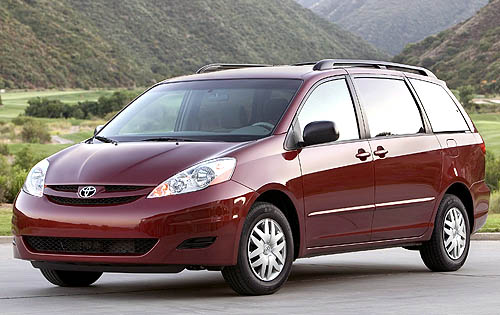 Luxury Red Toyota Sienna
 In January 2004, the second-generation Sienna was unveiled at the Detroit Auto Show. Production shifted to Princeton, Indiana, and the former Georgetown plant was retooled to build the second generation Camry Solara. To make the redesign more successful, Toyota assigned Yuji Yokoya as chief engineer on the new Sienna project. Yokoya and his family drove the previous Sienna over 53,000 miles (85,000 km) throughout North America to find weaknesses from the previous model. The new redesign continued to offer the CE, LE, and XLE trims along with a new, more luxurious, leather-trimmed XLE Limited model. The most distinguishable difference on the XLE Limited model is the horizontal chrome bar placed above the rear license plate. All Siennas were now powered by an updated ULEV certified 3.3-liter 3MZ-FE V6 engine paired with a new 5-speed automatic transmission. The gear-shift lever was also moved from the steering column to the lower-center center console area, and moved in a zig-zag pattern similar to the Lexus RX. New styling allowed for a coefficient of drag figure of 0.30 Cd. Fuel economy was rated at 17 city/25 highway (16 city/22 highway for AWD) under revised EPA estimates. The Sienna comes standard with anti-lock braking, brake assist, electronic brakeforce distribution, traction control and a tire-pressure monitor. Side torso airbags, and side curtain airbags were standard on certain 2004 and 2005 model trims while optional on others, but became standard on all 2006 trims. Vehicle Stability Control initially optional on lower trims became standard for 2008 models. The IIHS gives the Sienna an overall "Good" score in their frontal offset crash test with "Good" marks in all six measured categories. All 2006 models and later receive a "Good" overall score, while pre-2006 models without side airbags receive an "Acceptable" score for side impacts.
 Toyota Sienna Newest Interior Design
 Toyota Sienna Dashboard View
 The redesigned MY 2011 Sienna premiered at the Los Angeles Auto Show in early December 2009. It was designed at Calty studios and engineered at Toyota Technical Center in Ann Arbor, Michigan. The new Sienna arrived at dealers in February 2010. The Sienna will be offered in five trim levels, the Sienna grade, LE, XLE, Limited and for the first time the SE trim. The new SE offers revised bodywork, "Altezza" style clear tail lamps, 19-inch wheels, firmer suspension and revised steering tuning for a sportier ride. All-wheel-drive is only available with the V6 engine on the LE, XLE and Limited model trims. The previous 3.5-liter 2GR-FE continues, but for the first time the Sienna offers a four cylinder, the 1AR-FE. An Electric Power Steering (EPS) system replaces the previous hydraulic power steering system. Toyota expects EPA-estimated mileage figures of 19 mpg city/24 mpg highway for models powered by the 4-cylinder engine, 18 mpg city/24 mpg highway for 2WD V6 models ,and 16 mpg city/22 mpg highway for AWD models. An optional tow package for V6 models is rated to tow 3,500 pounds (1,600 kg). New features include an optional sliding second row with "Lounge Seating" recliner style chairs, a feature previously seen on the Lexus LS, and Toyota's keyless Smart Key System with push-button start. The rear seat entertainment option now uses a 16.4-inch LCD screen which operates in two view modes, a single 16:9-ratio widescreen or two separate 4:3-ratio split screens with separate wireless headphones. For safety the back-up camera comes with a new 180º panoramic view. Other new options include a Pre-Collision System (PCS) as well as an automatic highbeam dimmer, Safety Connect and a more advanced stability control system known as Vehicle Integrated Dynamics Management. A driver's knee airbag is now standard as well.Toyota is the first automaker to offer a factory installed auto-access seat for disabled people. The one-touch rotating, power ascending/descending lift-up seat can lower to within 19 inches of the ground.
 Posted in: Toyota


0 comments:
Post a Comment